Thursday, 20 April 2017

Things Fall Apart Historical Background


Things Fall Apart is an English-language novel by Nigerian author Chinua Achebe published in 1958 by William Heinemann Ltd in the UK. It is seen as the archetypal modern African novel in English, one of the first to receive global critical acclaim. It is a staple book in schools throughout Africa and is widely read and studied in English-speaking countries around the world. The title of the novel comes from a William Butler Yeats' poem, "The Second Coming".
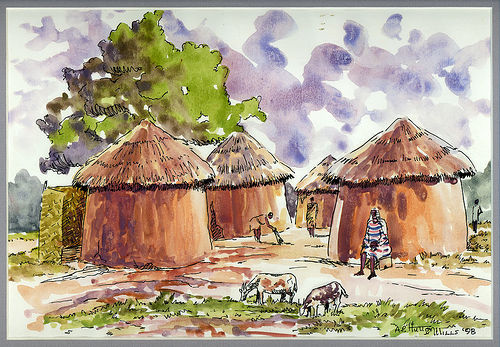

Image result for thing fall apartThe novel shows the life of Okonkwo, a leader and local wrestling champion in Umuofia—one of a fictional group of nine villages in Nigeria, inhabited by the Igbo people (in the novel, "Ibo"). It describes his family and personal history, the customs and society of the Igbo, and the influence of British colonialism and Christian missionaries on the Igbo community during the late nineteenth century.

SETTING
Time/Place

There is no specific date for the events in the novel.
Based on these same events, however, we can surmise that the novel takes place during the early nineteenth century to the early twentieth century.
The story occurs in Igbo territory in Nigeria.
Specifically, the plot unwinds in the villages of Umuofia, Mbaino and Mbanta.


Historical Context

British expansion had just gained relevance in the African interior.
Many of the missionaries, explorers and traders thought that the interior of Africa was a wild and dangerous place that was inhabited by primitive people.
There was a scramble for territorial control of Africa between 1870 and 1900 for two reasons:
1. Africa was an untapped source for raw materials that could fuel the Industrial  Revolution in Europe.

 2. Trade could be enhanced by using Africa as a stop off port on the way to the Middle East.

This scramble opened the door to the missionary's need to 'civilize' and 'enlighten' the population of this new colony/continent.
With the infiltration of these missionaries came churches and schools, both of which were instrumental in the colonizing process.

The over arching result of the European infiltration was:
                    1. The indigenous cultural and religious practices were rejected and viewed as uncivilized and heathen.
                    2. Tribal practices were outlawed.
                    3. Local judicial systems were replaced.
                    4. Trading posts and monetary systems replaced barter and rural systems of trade.


Social Context

The men are dominant and the women are subservient.
Social mobility is possible through personal achievement.
Success is measured by the number of barns one owns and titles that their wealth can buy.
The society is polygamous, and social prestige is accorded to a man that can afford to support many wives.
The acquisition of a bride is a solemn event that involves ritual and ceremony.
Children are a sign of virility.
Villagers feel a sense of obligation to help each other.
Being hospitable to each other is very important.
Conversation involves ritual - palm-wine, kola nut, alligator pepper - and proverbs.
Members of the clan are prohibited from killing each other.

Political Context

Approval of the entire clan is necessary before any major decision is made.
Egwugwu, the representative of the ancestral spirits, are integral in administering tribal justice.
Ndichie, the elders of the village, have a place of honour in the clan and their advice is respected.
The priests get their power from the Oracle, and their decisions are never questioned.

Religious Context

Ordinary people gain access to the gods through the Oracle.
The gods do not show themselves physically, but speak through the priests or priestesses.
The ancestors, embodied physically in the egwugwu, are revered.
There is the belief that the ogbanje, or spirit child, returns to plague its mother, ensuring that all her children die.
Twins are taboo and placed in the 'evil forest'.
The concept of the chi, or a person's identity in the spirit land, is important in Igbo religious beliefs.
A good chi can mean success, while a bad chi can mean misfortune.


 Economic Context

Sharecropping provides a financial base for young men who do not inherit a barn from their fathers, or are simply in a financial crises.
Cowrie shells are the medium of exchange.
The family unit provides the basis for economic success.
Each individual, even the children, has a specialized role that contributes to the family's financial success.


I hope this was helpful. We want to provide more original content for you. Please continue to support the blog by clicking on the advertisements whenever you visit our blog. This helps us to continue to provide free content for you.

TO AN ATHLETE DYING YOUNG QUESTIONS


1. Describe the feeling or mood at the beginning of the poem.
(b) Give a reason for the mood.

2. What does the word “shoulder-high” suggest in (a) Stanza one (b) Stanza two?

3. The poem is about
(a) A renowned runner
(b) A promising athlete
(c) Reflections on an athlete dying young.

4. “The road all runners come” suggests
(a) the route taken by all runners
(b) the path leading to death
(c) the road in which athletes compete.

5. Why does the poet refer to the athlete as “smart lad”?

6. “Eyes that shady might has shut” suggests
(a) the deep sleep of the athlete.
(b) the eternal sleep of the athlete
(c) tried eyes.

7. Give the meaning of “its echoes fade”.19

8. Why do you think the “laurel” in Stanza seven remains unwithered?

9. The poet’s attitude in the poem is one of
(a) acceptance (b) protest (c) anger (d) joy

10. The message that the poet wants to convey is
(a) athletes should die young.
(b) honour and glory are worn out by time.
(c) athletes are recognized only after they die.


I hope this was helpful. We want to provide more original content for you. Please continue to support the blog by clicking on the advertisements whenever you visit our blog. This helps us to continue to provide free content for you.

Monday, 17 April 2017

CSEC English Exam Countdown + We Need Your Help

You voted and we listened. 


We Need Your Help

I have received your emails, contact form messages, comments and other requests; most of these messages are requests from you for additional content (poetry analysis, short story analysis, CSEC English SBA, study tips, etc). It saddens me when I am unable to assist. Currently, the blog is created, designed, updated and maintained by one individual. As a full time teacher, it is challenging to meet ALL of your requests by myself. 

The solution to this is to have content writers come on board. Having content writers working with the blog will enable me to upload more original content (sample essays for English A and B, more sample questions, more poetry and short story analysis, sample ENGLISH SBA, etc )  However, currently  I are unable to hire content writer's because the blog does not generate an income to pay content creators.  

I need your help to grow the blog and to maintain as a free site for all persons who need CSEC English A and B assistance. 


How can you help? 

Here are some ways you can help: 

1. Click on the google advertisements along the side bar (There are three in total.) We make 0.1 cent from google when you click on these advertisements. If you continue to click on our adds it will all     add up.

2. Send us content. You can write guest posts for us and have them published with your byline. Send your posts to csecenglishclass@gmail.com.

3. Advertise with us. On average we have 35,000 page views per month from all around the    Caribbean. We are also recognized by search engines. For business inquiry email: lionbiz25@gmail.com 

4. Sign up for our Monthly Lesson Subscription (HERE) 

5. Join our family by becoming a Patron. Get all the behind scenes access to CSEC English Made Easy (HERE).

6. Donate HERE:


Thank you again for joining the team.

Saturday, 15 April 2017

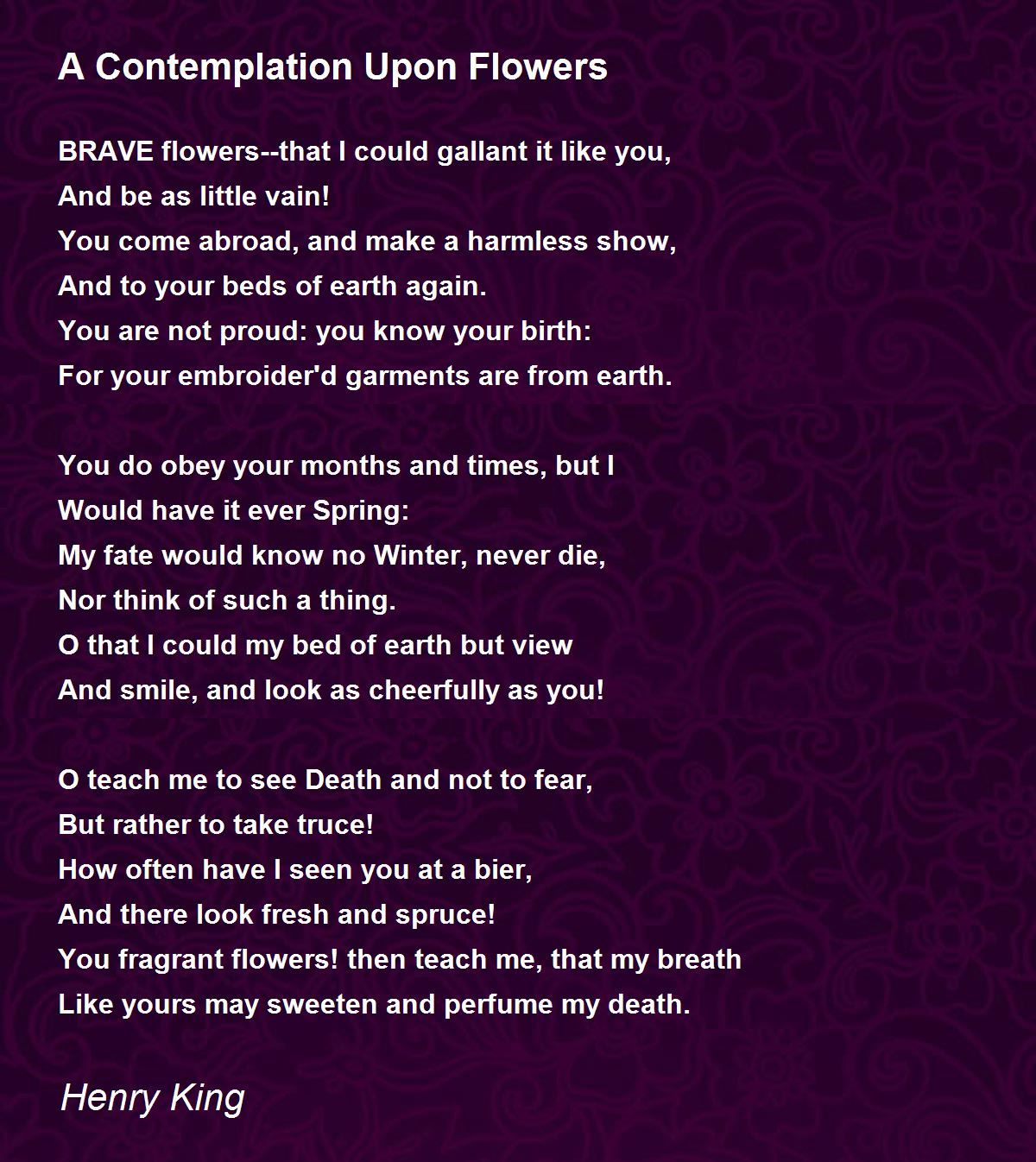
A Contemplation Upon Flowers by Henry King

                                                           STANZA 1
Stanza one centers on the characteristics of flowers.  They are gallant, humble, etc., and they return to the earth (figuratively, they die every winter--but this isn't revealed until later) after putting on a show.

His first lesson that he learnt was to become brave and to remember the place where the flower came from, as referred to line 1, 5-6 " Brave flowers that I could gallant it like you“ The persona wishes that he could be as brave as the flowers, who are aware of their allegiance to the earth. " You are not proud you know your birth for your embroidered garments are from earth."

They know their place and obey the order, or cycle, of life and death. The persona wishes that he could be this way because he is the opposite, he wants to live forever. The persona wants the flowers to teach him NOT to fear death, but to accept it.

Line 1 can also be identified as a literary device known as personification because brave flowers cannot gallant which only living things such as animals or humans can do. Also in line 5 and 6 can be identified as Biblical allusion another literary device because the bible in the books of John and Mathew Jesus talked about the lilies in the field where they are created and their birth place.

STANZA 2
Stanza two switches focus to the speaker:  he would rather it be always spring, so he'd never have a winter (again, so he'd never die, but this doesn't become clear until later:  winter is often used as a symbol of death).  He wishes he could go to the earth (his grave), and look as cheerful, and smile, as the flowers do when they go to their earth.

The second stanza the speaker learnt the second lesson which was to accept nature and their selves for today the flowers in the field may be beautiful and blooming but tomorrow the flowers know their beauty will not last forever where they may withered away and torn to pieces. In line 7 and 8 "You do obey your months and times, but i would have it ever spring;" metaphor can be found in the sentence.

STANZA 3
In stanza three, the focus on the speaker in stanza two combines with the focus on the flowers in stanza one, as the speaker asks the flowers to teach him to not fear death; to teach him that his breath may sweeten and perfume his death, as the flowers' breath sweetens theirs

. In the last stanza the poet learnt his last lesson which was to accept death as referred in line 13 and 14 " Oh teach me to see death and not to fear, but rather take truce." The only literary device that can be found is rhyme. In line 17 and line 18 " You fragrant flowers then teach me that my breath like yours may sweeten and perfumed my death."

The name was given to the poem because the poet shows that the speaker is studying the poem. This poem "A contemplation upon flowers by Henry King" is about a man who wants the flowers to teach him to become humble.

The comparison of the life of a simple flower is made to the life of a human, in the sense that we both are born, we both live, and we both must die. Majority of people fear death, but the flowers accept death with open arms and a smile. This poem by Henry King praises flowers for not only their humble lifestyles but also for their acceptance of death. Instead, the flowers taught him three lessons.

LITERARY DEVICES
. SIMILE
Stanza 1, line: The persona is wishing that he could be as brave as the flower. This implies that the persona does not think that he is brave, but a coward in the face of death.
Stanza 2, line 14: This is another comparison between the persona and the plant. The persona wishes that he could look death in the face and be cheerful, like the plant. Again, this emphasizes that he fears death.


EUPHEMISM
This phrase is a replacement for the word death. It softens death and makes it appear welcoming and pleasant.


IRONY
It is ironic that the flowers look so fresh and alive, when they are facing their very mortality, on the top of a casket. Death is a sad affair, yet the flowers are at their best when ushering people back to the earth.


PERSONIFICATION
The persona is speaking directly to the flowers and giving them human qualities, therefore, the whole poem is an example of the use of personification at its best. He even goes as far as to ask the flowers to teach him things that will allow him to acquire their qualities.


TONE
The tone of the poem is admiration, because the persona literally admires the flowers for its accepting attitude towards death.

MOOD/ ATMOSPHERE
The mood, or atmosphere of the poem is a pensive one. The persona is thinking about death, how he relates to it versus how others relate to it.


CONTRAST
A contrast in this poem is the persona's fear of death, versus the flowers' acceptance of it.

THEMES
Death is the overwhelming theme in this poem. The persona admires the way in which the flowers deal with death and wish to emulate it. Death is a very scary prospect for the persona.Nature is his willingness to accept nature as a worthy contrast to humans personality and approach to life. He uses the natural to highlight the failings and weaknesses of man.

I hope this was helpful. We want to provide more original content for you. Please continue to support the blog by clicking on the advertisements whenever you visit our blog. This helps us to continue to provide free content for you.

Powered by Blogger.