Showing posts with label Things Fall Apart. Show all posts

Sunday, 7 May 2017

Animal Imagery in Things Fall Apart

Igbos use animals in characterization, descriptions  and explanations as a way to understand the world in a more natural ways as well as a representation of their beliefs and wisdom.

The animal presence in their culture and beliefs represents their freedom and connection with nature and helps as a contrast with the modernized culture of Europe.

There are two notorious animal representations in the book.

One of them is the fable about a tortoise that meets his demise which is used to foreshadow Okonkwo's personality  and flaw that will eventuality lead to his death.

The other representation is the incident when Enoch , son of the snake-priest, in his way to demonstrate his devotion to his new religion kills a python and eat it, which is a sacred animal in the Igbo culture, and initiates a conflict between the clan and the Christians. This incident can be a symbolic form to show the death of the Igbo's religion.

This animalic illustration of the world is beautiful and somehow it feels so mystic and make you realize how wise nature can be.  It also highlights the lessons that can be learnt from nature.

Thursday, 4 May 2017

The Role of Women in the Novel: Things Fall Apart

While women in the Igbo society of the 1890s appear to be thoroughly subjugated to their male counterparts, are they depicted by Achebe as utterly powerless?

Kim Piper Hiatt has the following to say about the role of women in “Things Fall Apart”:

Discerning the role of women in Chinua Achebe’s novel Things Fall Apart (TFA) requires an attentive and unbiased reading of the novel. At first glance, the women in TFA may seem to be an oppressed group with little power, and this characterization is true to some extent. However, this characterization of Ibo women reveals itself to be prematurely simplistic as well as limiting, once the reader uncovers the diverse roles of the Ibo women throughout the novel.

An excellent example of powerful women in the Ibo village is found in the role they play in the Ibo religion. The women routinely perform the role of priestess. The narrator recalls that during Okonkwo’s boyhood, “the priestess in those days was a woman called Chika. She was full of the power of her god, and she was greatly feared” (17). The present priestess is Chielo, “the priestess of Agbala, the Oracle of the hill and the Caves” (49). There is an episode during which Chielo has come for Okonkwo and Ekwefi’s daughter Ezinma. We are told, “Okonkwo pleaded with her to come back in the morning because Ezinma was now asleep. But Chielo ignored what he was trying to say and went on shouting that Agbala wanted to see his daughter . . . The priestess screamed. ‘Beware, Okonkwo!’ she warned” (101). There is no other point in the novel in which we see Okonkwo “plead” with anyone, male or female, for any reason. We witness a woman not only ordering Okonkwo to give her his daughter, but threatening him as well. The fact that Okonkwo allows this is evidence of the priestess’s power. The ability of a woman to occupy the role of a priestess, a spiritual leader, reveals a clear degree of reverence for women being present in Ibo society.

Another example of such reverence for women is unveiled in the representation of the earth goddess, Ani. Ani is described a playing “a greater part in the life of the people than any other deity. She was the ultimate judge of morality and conduct.And what more, she was in close communion with the departed fathers of the clan whose bodies had been committed to earth” (36). It seems logical that a society that views its female members as inferior beings would not represent their most powerful deity as being a woman. Ani’s power is further illustrated through her role in the yam harvest. It is important that all the members of the clan observe the Week of Peace prior to the harvest in order, “to honor [their] great goddess of the earth without whose blessing [their] crops will not grow” (30). For a female spirit to possess such an important role in the success of the yam crops is indicative of the actual deep-rooted power of women. When Okonkwo breaks the Peace of Ani, Ezeani proclaims, “The evil you have one can ruin the whole clan. The earth goddess whom you have insulted may refuse to give us her increase, and we shall all perish” (30).

The idea of women’s power being attached to nature is also found in Chapter fourteen, when Okonkwo returns to his mother’s clan after being exiled from the Ibo village. Uchendu, reproaching Okonkwo for his sorrow about having to come to live with his mother’s clan, explains:
It’s true that a child belongs to its father. But when a father beats his child, it seeks sympathy in its mother’s hut. A man belongs to his fatherland when things are good and life is sweet. But when there is sorrow and bitterness he finds refuge in his motherland. Your mother is there to protect you. She is buried there. And that is why we say that mother is supreme (134).
Uchenda’s words reveal that women are viewed as the foundation of the clan and its people. They are the constant that can be relied upon; they are the nurturers andcaretakers of the people. These are not insignificant, powerless roles.    In addition to these notable examples of the power of these women, we observe women performing various roles sprinkled throughout the novel. We are told that it is “the women [who] weeded the farm three times at definite periods in the life of the yams, neither early or late” (33). This is an extremely important duty, considering that if this task is not carried out correctly, the yam crops will fail.

We also see women in their role as educators of their children. The education process is done in part through the ritual of storytelling. The narrator describes, “Low voices, broken now and again by singing, reached Okonkwo from his wives’ huts as each woman and her children told folk stories” (96). It is through storytelling that the children learn important lessons about the human condition, are taught the Ibo creation myths, such as the birds and the tortoise story, and master the art of communicating by retelling the stories themselves. As stated earlier in the novel, “Among Ibo the art of conversation is regarded very highly, and proverbs are the palm-oil with which words are eaten” (7). The Ibo women are playing a significant role in the facilitation of this learning, which is vital to their children’s ability to function within the Ibo culture.    At first glance, the role of women in Chinua Achebe’s Things Fall Apart may appear to unfairly limited in terms of their authority and power. Upon delving beneath this deceiving surface, one can see that the women of the clan hold some very powerful positions: spiritually as the priestess, symbolically as the earth goddess, and literally as the nurturers of the Ibo people, the caretakers of the yam crops and the mothers and educators of the Ibo children.

Thursday, 20 April 2017

Things Fall Apart Historical Background


Things Fall Apart is an English-language novel by Nigerian author Chinua Achebe published in 1958 by William Heinemann Ltd in the UK. It is seen as the archetypal modern African novel in English, one of the first to receive global critical acclaim. It is a staple book in schools throughout Africa and is widely read and studied in English-speaking countries around the world. The title of the novel comes from a William Butler Yeats' poem, "The Second Coming".
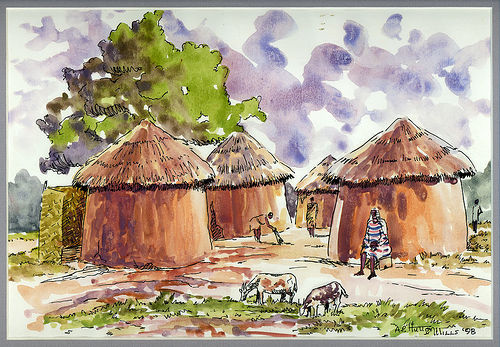

Image result for thing fall apartThe novel shows the life of Okonkwo, a leader and local wrestling champion in Umuofia—one of a fictional group of nine villages in Nigeria, inhabited by the Igbo people (in the novel, "Ibo"). It describes his family and personal history, the customs and society of the Igbo, and the influence of British colonialism and Christian missionaries on the Igbo community during the late nineteenth century.

SETTING
Time/Place

There is no specific date for the events in the novel.
Based on these same events, however, we can surmise that the novel takes place during the early nineteenth century to the early twentieth century.
The story occurs in Igbo territory in Nigeria.
Specifically, the plot unwinds in the villages of Umuofia, Mbaino and Mbanta.


Historical Context

British expansion had just gained relevance in the African interior.
Many of the missionaries, explorers and traders thought that the interior of Africa was a wild and dangerous place that was inhabited by primitive people.
There was a scramble for territorial control of Africa between 1870 and 1900 for two reasons:
1. Africa was an untapped source for raw materials that could fuel the Industrial  Revolution in Europe.

 2. Trade could be enhanced by using Africa as a stop off port on the way to the Middle East.

This scramble opened the door to the missionary's need to 'civilize' and 'enlighten' the population of this new colony/continent.
With the infiltration of these missionaries came churches and schools, both of which were instrumental in the colonizing process.

The over arching result of the European infiltration was:
                    1. The indigenous cultural and religious practices were rejected and viewed as uncivilized and heathen.
                    2. Tribal practices were outlawed.
                    3. Local judicial systems were replaced.
                    4. Trading posts and monetary systems replaced barter and rural systems of trade.


Social Context

The men are dominant and the women are subservient.
Social mobility is possible through personal achievement.
Success is measured by the number of barns one owns and titles that their wealth can buy.
The society is polygamous, and social prestige is accorded to a man that can afford to support many wives.
The acquisition of a bride is a solemn event that involves ritual and ceremony.
Children are a sign of virility.
Villagers feel a sense of obligation to help each other.
Being hospitable to each other is very important.
Conversation involves ritual - palm-wine, kola nut, alligator pepper - and proverbs.
Members of the clan are prohibited from killing each other.

Political Context

Approval of the entire clan is necessary before any major decision is made.
Egwugwu, the representative of the ancestral spirits, are integral in administering tribal justice.
Ndichie, the elders of the village, have a place of honour in the clan and their advice is respected.
The priests get their power from the Oracle, and their decisions are never questioned.

Religious Context

Ordinary people gain access to the gods through the Oracle.
The gods do not show themselves physically, but speak through the priests or priestesses.
The ancestors, embodied physically in the egwugwu, are revered.
There is the belief that the ogbanje, or spirit child, returns to plague its mother, ensuring that all her children die.
Twins are taboo and placed in the 'evil forest'.
The concept of the chi, or a person's identity in the spirit land, is important in Igbo religious beliefs.
A good chi can mean success, while a bad chi can mean misfortune.


 Economic Context

Sharecropping provides a financial base for young men who do not inherit a barn from their fathers, or are simply in a financial crises.
Cowrie shells are the medium of exchange.
The family unit provides the basis for economic success.
Each individual, even the children, has a specialized role that contributes to the family's financial success.


I hope this was helpful. We want to provide more original content for you. Please continue to support the blog by clicking on the advertisements whenever you visit our blog. This helps us to continue to provide free content for you.

Wednesday, 15 March 2017

Things Fall Apart Practice Question


In the exam 10 marks are also allocated for structure, development and competence. 

Image result for things fall apart
source


In the novel, Things Fall Apart, we are constantly kept aware of the physical and social environment.

a) Describe the physical environment in which the action takes place.(8 marks)

b) Describe the nature of the family relationships in the society in which the novel is set. (6 marks)

c) Describe the religious conflicts that emerge. (6 marks)

d) Discuss the view that it is because of the social environment that the religious conflicts arise. (5 marks)
                                                                                                                 
                                                                                                                       TOTAL MARKS= 35

Thursday, 20 October 2016

Things Fall Apart -Analysis of Chapter 7

Chapter 7

With the killing of Ikemefuna, Achebe creates a devastating scene that evokes compassion for the young man and foreshadows the fall of Okonkwo, again in the tradition of the tragic hero. Along the way, the author sets up several scenes that juxtapose with the death scene:

The opening scene of the chapter shows the increasing affection and admiration Okonkwo feels for Ikemefuna, as well as for Nwoye.
On the journey with Ikemefuna and the other men of Umuofia, they hear the "peaceful dance from a distant clan."

In Chapter 2, the author comments that the fate of Ikemefuna is a "sad story" that is "still told in Umuofia unto this day." This observation suggests that the decision to kill Ikemefuna was not a customary one. Before dying, Ikemefuna thinks of Okonkwo as his "real father" and of what he wants to tell his mother, especially about Okonkwo. These elements combined suggest that the murder of Ikemefuna is senseless, even if the killing is in accordance with the Oracle and village decisions.

The murder scene is a turning point in the novel. Okonkwo participates in the ceremony for sacrificing the boy after being strongly discouraged, and he delivers the death blow because he is "afraid of being thought weak." At a deep, emotional level, Okonkwo kills a boy who "could hardly imagine that Okonkwo was not his real father" — someone whom Okonkwo truly loves as a son. Okonkwo has not only outwardly disregarded his people and their traditions, but he has also disregarded his inner feelings of love and protectiveness. This deep abyss between Okonkwo's divided selves accounts for the beginning of his decline.

For the first time in the novel, Okonkwo's son, Nwoye, emerges as a major character who, in contrast to his father, questions the long-standing customs of the clan. Achebe begins to show the boy's conflicting emotions; he is torn between being a fiercely masculine and physically strong person to please his father and allowing himself to cherish values and feelings that Okonkwo considers feminine and weak.

Resource Site: cliffnotes.com

Wednesday, 19 October 2016

Summary of Chapter 6- Things Fall Apart

On the second day of the festival, everyone gathers at the village playing field to watch the wrestling contest between men of the village and men of a neighboring village. The first matches, between two teams of boys fifteen or sixteen years old, provide entertainment and excitement before the main events. One of the victorious boys is Maduka, the son of Okonkwo's good friend Obierika. Neighbors greet each other and tension builds until matches between the real wrestlers begin.

The current priestess of the Oracle, Chielo, talks casually with Ekwefi about Okonkwo's attack on her and about Ekwefi's daughter Ezinma, of whom Chielo seems particularly fond.

As the drums thunder, two teams of twelve men challenge each other. Many expect the final match between the two greatest fighters in the villages to be uneventful because of the similar styles of the two wrestlers. However, the spectators are thrilled when the local fighter, Okafo, takes advantage of one of his opponent's moves and suddenly defeats him. The crowd carries the victorious Okafo on their shoulders with pride.

Resource Site: https://www.cliffsnotes.com

Thursday, 13 October 2016

Things Fall Apart- Analyzing Okonkwo’s Personality

• Deep down Okonkwo really cares for the persons around him; however, caring was an attribute  of his father and he wants to be the complete opposite of him( he sees caring and showing feelings as womanly things)  thus  shows a lot of anger towards his family.

• Okonkwo is a good father, although he beats his children and does not treat them with affection. He beats his children so that they will become successful and hardworking and not lazy as Unoka, his father.

• Okonkwo is a good role-model and motivation to the clan because he is the epitome of a hard-working and successful man. This is due to the fact that, he started with nothing and became one of the most successful persons in the village.

• Okonkwo is a “No-non sense” person. He is all work and no play as he sees festivities, gatherings and time away from work as idleness and irrelevant events. This makes him angry and listless.

• Okonkwo cares too much about others opinions. He does not want people of the clan to look at him and say or even think he is weak or compare him to his father. This is shown when he decides to go with the men to kill Ikemefuna, although an elder told him not to.

•Okonkwo uses his father to judge others. An example of this is he sees similarities between his father and any man who he considers weak or feminine.  For instance whenever Okonkwo thinks that Nwoye is portraying a lazy character. he despised it and would curse and hit him. He does this because he is judging his son based on his father's behaviour.

                                                                                             written by: Students of Dinthill Technical

Wednesday, 12 October 2016

Things Fall Apart: The Role of Women in Society

Much of the traditional Igbo life presented in this novel revolves around structured gender roles.

Essentially all of Igbo life is gendered, from the crops that men and women grow, to characterization of crimes. In Igbo culture, women are the weaker sex, but are also endowed with qualities that make them worthy of worship, like the ability to bear children.

The dominant role for women is: first, to make a pure bride for an honourable man, second, to be a submissive wife, and third, to bear many children.

The ideal man provides for his family materially and has prowess on the battlefield. The protagonist in the novel is extremely concerned with being hyper-masculine and devalues everything feminine, leaving him rather unbalanced.

Much of the gender theme in the book centres around the idea of balance between masculine and feminine forces – body and mind/soul, emotionality and rationality, mother and father. If one is in imbalance, it makes the whole system haywire.


Things Fall Apart: Summary of Chapter 5


Just before the harvest, the village holds the Feast of the New Yam to give thanks to the earth goddess, Ani. Okonkwo doesn’t really care for feasts because he considers them times of idleness. The women thoroughly scrub and decorate their huts, throw away all of their unused yams from the previous year, and use cam wood to paint their skin and that of their children with decorative designs. With nothing to do, Okonkwo becomes angry, and he finally comes up with an excuse to beat his second wife, Ekwefi. He then decides to go hunting with his gun. Okonkwo is not a good hunter, however, and Ekwefi mutters a snide remark under her breath about “guns that never shot.” In a fit of fury, he shoots the gun at her but misses.

The annual wrestling contest comes the day after the feast. Ekwefi, in particular, enjoys the contest because Okonkwo won her heart when he defeated the Cat. He was too poor to pay her bride-price then, but she later ran away from her husband to be with him. Ezinma, Ekwefi’s only child, takes a bowl of food to Okonkwo’s hut. Okonkwo is very fond of Ezinma but rarely demonstrates his affection. Obiageli, the daughter of Okonkwo’s first wife, is already there, waiting for him to finish the meal that she has brought him. Nkechi, the daughter of Okonkwo’s third wife, Ojiugo, then brings a meal to Okonkwo.


Monday, 26 September 2016

Things Fall Apart Background Information

Things Fall Apart is an English-language novel by Nigerian author Chinua Achebe published in 1958 by William Heinemann Ltd in the UK. It is seen as the archetypal modern African novel in English, one of the first to receive global critical acclaim. It is a staple book in schools throughout Africa and is widely read and studied in English-speaking countries around the world. The title of the novel comes from a William Butler Yeats' poem, "The Second Coming".

The novel shows the life of Okonkwo, a leader and local wrestling champion in Umuofia—one of a fictional group of nine villages in Nigeria, inhabited by the Igbo people (in the novel, "Ibo"). It describes his family and personal history, the customs and society of the Igbo, and the influence of British colonialism and Christian missionaries on the Igbo community during the late nineteenth century.

SETTING
Time/Place

There is no specific date for the events in the novel.
Based on these same events, however, we can surmise that the novel takes place during the early nineteenth century to the early twentieth century.
The story occurs in Igbo territory in Nigeria.
Specifically, the plot unwinds in the villages of Umuofia, Mbaino and Mbanta.


Historical Context

British expansion had just gained relevance in the African interior.
Many of the missionaries, explorers and traders thought that the interior of Africa was a wild and dangerous place that was inhabited by primitive people.
There was a scramble for territorial control of Africa between 1870 and 1900 for two reasons:
     
           1. Africa was an untapped source for raw materials that could fuel the Industrial  Revolution in           Europe.

           2. Trade could be enhanced by using Africa as a stop off port on the way to the Middle East.

This scramble opened the door to the missionary's need to 'civilize' and 'enlighten' the population of this new colony/continent.

With the infiltration of these missionaries came churches and schools, both of which were instrumental in the colonising process.

The over arching result of the European infiltration was:
                    1. The indigenous cultural and religious practices were rejected and viewed as     uncivilized and heathen.
                    2. Tribal practices were outlawed.
                    3. Local judicial systems were replaced.
                    4. Trading posts and monetary systems replaced barter and rural systems of trade.


Social Context

The men are dominant and the women are subservient.
Social mobility is possible through personal achievement.
Success is measured by the number of barns one owns and titles that their wealth can buy.
The society is polygamous, and social prestige is accorded to a man that can afford to support      many wives.
The acquisition of a bride is a solemn event that involves ritual and ceremony.
Children are a sign of virility.
Villagers feel a sense of obligation to help each other.
Being hospitable to each other is very important.
Conversation involves ritual - palm-wine, kola nut, alligator pepper - and proverbs.
Members of the clan are prohibited from killing each other.

Tuesday, 13 September 2016

Things Fall Apart Audiobook

Thursday, 7 July 2016

Things Fall Apart Guided Reading Questions

Chapter 1   

How was Okonkwo's identity in the village formed? Give some details of Okonkwo's  physical identity.
How would Okonkwo describe a successful man?
Describe Unoka. In whose eyes was he a failure? Was he a starving artist? pacifist?
Compare Unoka and Okonkwo.

Chapter 2  

Describe some of the traditions and rituals.
How is justice brought upon the tribal people? Who decides?
How did Ikemefuna come to Umuofia?
How did Okonwko rule his household?
Okonkwo's life was dominated by fear. Describe the fear that dominated his life.  
For Okonkwo is gentleness a weakness? Explain
Describe Ikemefuna.

Chapter 3  

Describe Okonkwo's childhood.
Where do people go to obtain advice for troubles? the future?
What ritual surrounded seeing the Oracle?
What advice did the Oracle give to Okonkwo's father?
How are diseased/dying people treated in the tribe? How are they buried?
What privileges are given to a man's first wife?
What was needed to approach Nwakibie for some yams?

Chapter 4  

Okonkwo had no patience for less successful men.
Does hard work deserve success?
How did the Ibo judge a person?
At one point, Okonkwo says that affection is a sign of weakness. Do you agree?
How did Okonkwo break the Week of Peace?
What emphasis is placed on the "gods" in the tribe?


Chapter 5  

Who was the most important god, Ani? (Judge of morality/conduct)
Describe the New Yam Festival.
Why was Okonkwo fond of Ezinma?

Chapter 6

What do you think is the significance of the wrestling matches?

Powered by Blogger.